Showing posts with label Chevrolet. Show all posts

Tuesday, March 1, 2011

Chevrolet Corvette Grand Sport, 2010

Chevrolet Corvette Grand Sport, 2010


The Chevrolet Corvette Grand Sport combines the Corvette's LS3-based powertrain with unique, wide-body styling and a racing-bred suspension for a distinctive model that delivers a great balance of road and race track performance. It is offered in both coupe and convertible body styles, with either a six-speed manual or six-speed automatic transmission. The LS3 6.2L engine is rated at 430 horsepower (321 kW) and 424 lb.-ft. of torque (575 Nm) with the standard exhaust system. An optional two-mode exhaust system elevates the power ratings to 436 horses (325 kW) and 428 lb.-ft. (580 Nm).

The Chevrolet Corvette Grand Sport replaces the Corvette's previous Z51 package and brings a greater degree of handling performance, with wider wheels and tires; revised shock, stabilizer bar and spring specifications; and specific gearing. The equipment enables cornering capability of 1.0 g, as well as a 0.2-second improvement in 0-60 acceleration vs. standard LS3-powered models.

Chevrolet Corvette Grand Sport coupe models equipped with the manual transmission are uniquely outfitted for race track competition, too, with a dry-sump oiling system, differential cooler and a rear-mounted battery.

The Grand Sport history
The original Chevrolet Corvette Grand Sport was a promising idea that led to the production of five special prototypes in 1963. The project was later shelved, following GM's agreement to stay out of manufacturer-backed motorsports.

The five prototypes were based on the styling of the 1963 Corvette and were hand-assembled under Duntov's watchful eye. But while they looked like production models, the prototypes were purpose-built race cars that shared little with their assembly-line cousins. Duntov also oversaw the Chevrolet Corvette Grand Sport engine program that featured a special, 377-cubic-inch small-block V-8 with side-draft carburetors.

Chevrolet Camaro Transformers, 2010

Chevrolet Camaro Transformers, 2010


Fans of the new Chevrolet Camaro and the blockbuster Transformers movies can now combine their love of the car and the films with the Chevrolet Camaro Transformers Special Edition announced today at Comic-Con in San Diego.

Features such as an EPA-rated 29 highway mpg on the V6-powered Chevrolet Camaro, Bluetooth phone connectivity, USB connectivity, XM Satellite Radio and OnStar combined with Transformers design cues add to the car's status as a 21st century sports car.

While the aggressive styling of the Chevrolet Camaro is unmistakable, true Transformers fans will notice some of the unique, but subtle features of the Chevrolet Camaro Transformers Special Edition.
Chevrolet Camaro Transformers

The 2010 Chevrolet Camaro Transformers Special Edition includes the following:
    * Autobot® shield on the driver and passenger side panels
    * Autobot® shield on each of the four wheel's center cap
    * Autobot® shield embroidered on interior center console
    * "Transformers" logo on driver and passenger doors' sill plates
    * "Transformers" logo embedded into the hood rally stripes
    * High-gloss black center rally stripe package
    * Manufacturer's suggested retail price of package: $995

Dealers are now taking orders for this car. Customers can order the Transformers Special Edition as either a Rally Yellow LT or SS model. The optional RS appearance package can also be added.

The V6-powered Chevrolet Camaro uses a 3.6L engine with variable valve timing to optimize performance and fuel economy. It is SAE-certified at 304 horsepower (227 kW) and 273 lb.-ft. of torque (370 Nm). A six-speed manual transmission is standard with the 3.6L engine; a Hydra-Matic 6L50 electronically controlled six-speed automatic, with TAPshift control, is available.

The high-performance Chevrolet Camaro SS is equipped with a powerful 6.2L V-8, with a choice of a six-speed manual or six-speed automatic transmission. Manual transmission-equipped models receive the LS3 engine, SAE-certified at 426 horsepower (318 kW) and 420 lb.-ft. of torque (569 Nm). It is paired with a TR6060 six-speed transmission.

Chevrolet Camaro SS Indy 500 Pace Car, 2009

Chevrolet Camaro SS Indy 500 Pace Car, 2009


The 2010 Chevy Camaro Indianapolis 500 pace car is a 21st century sports car that looks to the future with a nod to both the car's and the race's heritage. The first year for Camaro to pace the Indianapolis 500 was in 1967, the year the Camaro made its debut. Camaro has since paced the race in 1969, 1982, 1993 and 2009.

2010 pace car features an Inferno Orange Metallic paint scheme with White Diamond rally stripes that travel from the front to the rear over the top of the body, as well as extending to the instrument panel. The design is a modern interpretation of the original rally stripe that debuted on the 1969 Indianapolis 500 Pace Car.

The 2010 pace car is equipped with a stock 400 hp 6.2L V-8, an RS appearance package and leather interior with Inferno Orange interior accents. The pace car also features unique design cues that further enhance the Camaro's head-turning design. Features unique to the pace car:
    * 2010 Indianapolis 500 event logo painted on doors and embroidered on driver and passenger headrests
    * 2010 Indianapolis 500 event logo badges on front fenders
    * All-new front grille insert that Chevrolet plans to offer as a future Camaro accessory
    * Amber lens tail lamps
    * Complete safety strobe light system with custom interior light bar in the rear window (no rooftop light bar)
    * All-new GM Accessory floor mats with red and orange accent stitching

Chevrolet Camaro SS, 2010

Chevrolet Camaro SS, 2010


The Design features

With a design that is very close to the original concept, the 2010 Chevrolet Camaro acknowledges its heritage from the first-generation Camaro, produced from 1967 through 1969. The two-door sports coupe features classic proportions over a 112.3-inch (2,852 mm) wheelbase. The overall length of the Chevrolet Camaro is 190.4 inches (4,836 mm); width and height are 75.5 inches (1,918 mm) and 54.2 inches (1,376 mm), respectively.
The long hood and short deck are pushed to the far corners of the muscular fender forms and a fast, 67-degree rake windshield contributes to aerodynamic performance that includes a 0.37 coefficient of drag (Cd) on V-6 models and a slightly sleeker 0.35 Cd on the V-8-powered SS model.

The Interior details
Inside the four-passenger cabin, a well-executed balance of heritage, modern design and attention to detail conveys simplicity and refinement with contemporary details in the cluster, switches, dials and lighting.

The Safety
The Chevrolet Camaro offers a comprehensive system of safety features - starting with a robust body structure and integral safety cage around the passenger compartment. High-strength steel and ultra high-strength steels are used in key areas throughout the structure.

The Powertrains
When it comes to performance, the 2010 Chevrolet Camaro delivers in unexpected ways. An advanced 3.6L direct-injected V-6 with variable valve timing is standard on LS and LT models. It offers power and efficiency, with 304 horsepower (227 kW) and EPA-rated 29 mpg in highway driving.
The performance-oriented Chevrolet Camaro SS offers a pair of 6.2L V-8s, including one with Active Fuel Management that helps improve fuel economy by shutting down four cylinders during certain light-load driving conditions. That model delivers 25 mpg in EPA-rated highway fuel economy.

3.6L direct injection V-6
Chevrolet Camaro's 3.6L direct injection (DI) V-6 delivers more power through increased efficiency, while maintaining fuel economy and lowering emissions - including a 25-percent drop in cold-start hydrocarbon emissions. Direct injection optimizes fuel delivery to the combustion chamber by introducing fuel closer to the combustion chamber. The fuel injectors are located beneath the intake ports and fuel is injected directly into the cylinder. The result is better efficiency in the combustion process leading to increased fuel efficiency at part and full throttle.

The 3.6L DI engine produces 304 horsepower (227 kW) at 5,900 rpm and 273 lb.-ft. of torque (370 Nm) at 5,200 rpm. Its 60-degree cylinder block and cylinder heads are cast aluminum to help reduce mass. A forged steel crankshaft provides optimal strength in the bottom end. The cylinder heads include four valves per cylinder, with a dual overhead camshaft design incorporating infinitely variable cam phasing.
A full dual exhaust system, with dual catalytic converters, helps reduce back pressure for optimum power. It also helps the engine reach operating temperature quicker to help burn off cold-start emissions. And despite a compression ratio of 11.3:1, the 3.6L DI engine is designed to run on regular gas.

The Brakes
Front brakes for LS and LT models include single-piston calipers with 321 mm x 30 mm rotors. For long life, performance and consistent feel, organic, non-asbestos compounds are used with FE2 brakes. At the rear are vented rear discs measuring 315 mm x 30 mm, with a single-piston aluminum caliper.
The SS front brake package includes Brembo 355 mm x 32 mm vented rotors with four-piston aluminum calipers. Semi-metallic brake linings are used at all four corners on FE3 models for superior fade resistance and pedal feel. The rear brakes are vented Brembos measuring 365 mm x 28 mm, with aluminum four-piston calipers.

Sunday, January 23, 2011

Chevrolet Corvette C6 ZR1

The Chevrolet Corvette C6 ZR1 is a high performance version of the Chevrolet Corvette C6. Both the C3 from 1969–1971 and C4 Corvettes from 1990-1995 had ZR-1 models. However, the C6 variant is officially labeled as the "ZR1" while previous variants had a hyphen between the ZR and 1, as in "ZR-1". The Corvette ZR1 engine is a heavily modified version of the LS3, designated the LS9. Producing 638 hp (476 kW; 647 PS) and 604 ft·lbf (819 N·m) of torque, it is the most powerful production Corvette to date. The LS9 has a sixth-generation Eaton TVS R2300 roots 4-lobe supercharger with intercoolers from Behr, utilizing an air-to-water, dual-brick design. The supercharger's four-lobe design offers improved efficiency over three-lobe models. To avoid changes to the hood appearance, the supercharger's output was split into two halves. Each cylinder bank has an intercooler. The cylinder walls of the LS3 are thicker than the Z06's LS7 since the LS3 has a smaller bore. Oil squirters under each piston help lubricate the pistons and cylinder walls are used for the first time in a production Corvette. Connecting rods and the inlet valve are made of titanium. Heads are made from a special heat resistant aluminum alloy. The camshaft lift was reduced from the LS7's to improve idle quality. With the addition of the supercharger to the 6.2 liter LS9, the higher lift camshaft was no longer necessary to achieve horsepower targets. Lubrication is provided by an improved version of the LS7's dry sump system. The new system increases oil capacity from 8.0 to 10.5 quarts (9.94 liters). A new dual gerotor oil pump increases scavenge performance and oil pressure, enabling oil to be delivered under the most extreme conditions. Due to the increased pressure, the Ultraguard Gold UPF48R oil filter is required. The LS7 oilpan is used for the LS9 with the addition of an oil cooler which is mounted on the left side of the pan. With the 2011 model, GM offers the optional "Corvette Engine Build Experience," where the customer visits the General Motors’ Performance Build Center to help assemble the LS9 for the ZR1 purchased. Factory technicians supervise the process and the normal warranty covers the engine built by the customer's hands. The ZR1 flywheel has been improved over the 2008 Z06. The flywheel was upgraded by going from six to a nine bolt design and cutting off nearly 9.8 ounces (278 grams) for improved throttle response and acceleration. The transmission is a 6-speed manual Tremec TR6060 with a MH3 gearset. The 2008 Z06 featured the MM6 gearset. Due to the gear ratios in the transmission and engine output, the Z06 reaches top speed in 5th gear, using 6th gear for gains in fuel efficiency at highway speeds; the ZR1 hits top speed in 6th gear.

The differential is a limited slip with carbon and steel plates. The differential uses SAE 5W-80 Dexron LS lubricant. The two half shafts have different diameters (33mm left, 40mm right), designed to prevent resonanace during acceleration and reduce the chances of axle hop occurring.
Production vehicles are hand assembled in Bowling Green, Kentucky. The ZR1 engines are built at the General Motor Performance Build Center in Wixom, Michigan. The name of the ride control system is Magnetic Selective Ride Control (MSRC). MSRC is provided by Beijing West Industries. The system uses two modes of control: Tour and Sport. The system offers standing start launch modifications. When launching the ZR1 from a standing start, the shocks are completely softened on launch and stiffened on rebound. The softened shocks on launch aid the ZR1 by allowing weight to transfer to the rear, aiding traction. The ride control standing launch modifications are designed to minimize bounce. The ZR1 features a double-wishbone suspension system and Magnetic Selective Ride Control—which adjusts shock-absorber damping in real time to either "Tour" or "Sport" mode. The MSRC shocks are automatically adjusted based on driving conditions and vehicle dynamics (cornering, braking, etc) for optimal handling. The system is adjusted every millisecond to provide sharp handling during spirited driving, and a smooth ride while cruising. The new high-end magnetic suspension system enables the ZR1 to deliver great handling and grip to achieve 1.10 g of average lateral acceleration. The chassis, similar to the 2008 Z06, is made of aluminum. To cut weight, many panels are made of carbon fiber. Panels made of carbon fiber are the fenders, hood, roof, splitter, and rocker extensions. To prevent the sun from damaging the binder in the exposed carbon fiber composite body panels, panels are protected with a clear-coating. The rear wheels are the largest ever mounted on a production Corvette with 335/25 Michelin Pilot Sport PS2 tires on 20 in (510 mm) wheels. The official curb weight of the 2009 ZR1 was released to be 3,352 lb (1,520 kg). The 260 mm (10 in) ZF-Sachs twin-plate clutch supplants Z06's 290 mm (11 in) single-plate unit to reduce inertia for better shift feel. The lower clamping force reduces clutch-pedal effort. The clutch upgrade is considered a dramatic improvement over the unit employed within the Z06.


Video from Chevrolet Corvette C6 ZR1


Video from Chevrolet Corvette C6 ZR1

Elegant Chevrolet Corvette C6 ZR1 with silver color. The front brake rotors are similar carbon ceramic design as those employed in the Ferrari FXX track car, the difference being a diameter reduction from 15.75 in (400 mm) to 15.5 in (390 mm) for added wheel clearance. The front calipers are Brembo 6-piston units. Rear calipers are Brembo 4-piston units. The rear brakes are 15 in (380 mm) carbon ceramic rotors, originally employed as the Enzo Ferrari's front rotors. Same as those used in the BMW M3 GTS. Both front and rear pads have twice the contact area of the Z06's, as well as the addition of brake pad wear sensors. The brake master cylinder, booster, ABS unit and system controller are now sourced from Bosch in place of Delphi.As a result, the ZR1 will stop from 60 mph (97 km/h) in a current production car record breaking 96 feet (29.3 m).

Elegant interior of Chevrolet Corvette C6 ZR1. A unique fuel pressure regulator varies pressure between 36.3 psi (250 kPa) and 87.0 psi (600 kPa) depending on rpm.

Beautiful yellow of Chevrolet Corvette C6 ZR1

Elegant red of Chevrolet Corvette C6 ZR1

Amazing Chevrolet Corvette C6 ZR1 with red color

Sport blue of Chevrolet Corvette C6 ZR1. The ZR1 features blue badges, engine valve covers, and brake calipers. The hood contains a polycarbonate window which allows the intercooler to be viewable. Doors and rear body are from the 2008 Z06. A larger than previous model spoiler spans the top rear bumper. Functional fender vents provide engine cooling. The lettering "LS9 Supercharged" can be viewed on top of the plastic supercharger cover through the hood window.

Monday, December 13, 2010

2010 Chevrolet Corvette c6

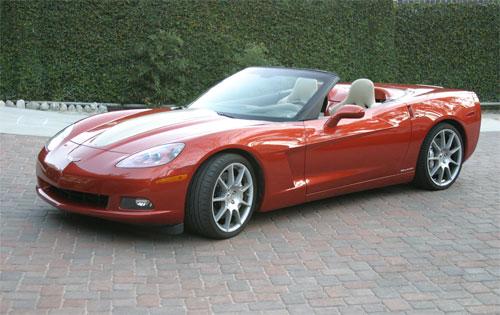
The Chevrolet Corvette (C6) is a sports car produced by the Chevrolet division of General Motors introduced for the 2005 model year. The current generation Corvette is the first with exposed headlamps since the 1962 model.


Red Chevrolet Corvette c6 without top cover


Racing cars by Chevrolet Corvette c6


Various of Chevrolet Corvette c6


Impressive Chevrolet Corvette c6


2010 Chevrolet Corvette c6 with the top speed


The 2010 Chevrolet Corvette base model comes equipped with the 430 horsepower LS3 V8 and base model Corvettes are available as either a coupe or convertible. The 2009 base model Corvette comes with either an automatic or manual transmission and launch control is available on all manual transmission models for the 2010 model year.


View of 2010 Chevrolet Corvette c6 in two models


Sporty 2010 Chevrolet Corvette c6


Luxury Chevrolet Corvette c6


Front of 2010 Chevrolet Corvette c6


Engine detail of 2010 Chevrolet Corvette c6


Exotic lighting of 2010 Chevrolet Corvette c6

Monday, November 29, 2010

2011 Chevrolet Traverse

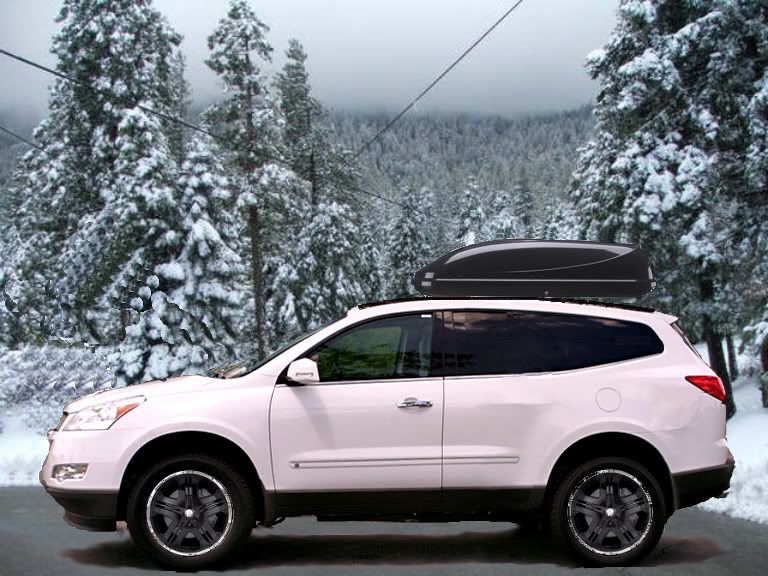
The Chevrolet Traverse offers distinctive styling and a purportedly sportier driving experience than its GMC Acadia and Buick Enclave siblings. Competitors include the Toyota Highlander, Mazda CX-9 and Hyundai Veracruz. The 2011 Chevrolet Traverse is available in all-wheel and front-wheel drive and features a powerful 3.6L V6 direct-injection engine with an automatic transmission; while some automotive experts have speculated that the 2011 or 2012 Traverse line will include a hybrid model.


2011 Chevrolet Traverse in dark


Active 2011 Chevrolet Traverse


Sporty 2011 Chevrolet Traverse


2011 Chevrolet Traverse for traveling


Red 2011 Chevrolet Traverse


Advance interior of 2011 Chevrolet Traverse


Wheels of 2011 Chevrolet Traverse


Interior of 2011 Chevrolet Traverse


Front of 2011 Chevrolet Traverse


Luxury 2011 Chevrolet Traverse

Wednesday, July 28, 2010

Chevrolet Stingray Concept, 2009

Chevrolet Stingray Concept, 2009


The Chevrolet Stingray Concept design is influenced by the original Stingray race car, introduced in 1959, but also draws on Corvette heritage cues from other generations.
It brings them together in a futuristic shape that seems to be equal parts racecar and space ship.

Related Posts Plugin for WordPress, Blogger...