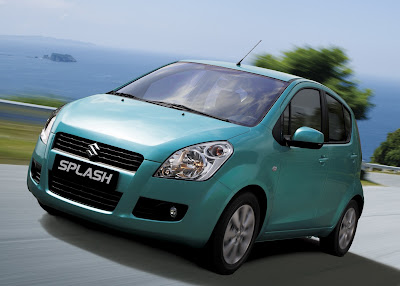
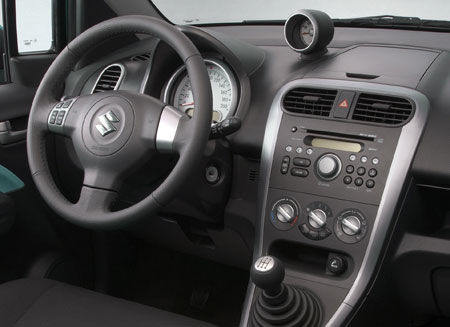
The Suzuki Alto is a small car (kei car) designed by Suzuki. Its selling points include low price and good fuel economy. The model was introduced in 1979 and has been built in many countries worldwide.The 1st generation (SS30/40), introduced in May 1979, was a 3-door cargo version of the Fronte passenger car, equipped with a folding rear seat. On introduction, the Alto received the T5B two-stroke 539 cc (SS30) three-cylinder engine, producing 28 PS (21 kW) at 5,500 rpm. The Alto was a "micro sensation" when introduced, largely due to its rock bottom price of ¥470,000 (circa $1,900 in 1979, at a time when the cheapest Ford Pinto cost $4,999). This bargain price was made possible by a number of Japanese special concessions for commercial vehicles: The engine did not require twin catalysts, unlike in the Fronte. Two less doors provided another saving, as did the exemption from commodity tax. The Alto was a sensation, and other producers such as Subaru (with the "Family Rex") quickly followed suit. The 2nd generation (CA71) was introduced in September 1984. It continued with the SS40's F5A engine, but also became available with turbocharged and multi-valve engines thereof, mainly in the "Works" series. In December 1984 a 4-wheel drive version (CC71) was added. Performance versions of the Alto first appear in 1985 when a turbocharged engine was made available. It gradually acquired more performance-related modifications until the Works version was introduced in February 1987. The Alto Works was the first kei-car to reach the legal limit of 64 PS (47 kW). It acquired considerable popularity, with models of it still made by Fujimi. A 5-door body (identical to the Fronte's) became available in October 1985.
SUZUKI ALTO
 The 3rd generation (CL/CM11) replaced the CA71 in September 1988. This was the last generation of Alto to have an associated Fronte model. It had strikingly angular styling, with an unusual glazed C-pillar on the 5-door. Another curiosity of this generation was the availability of a version with sliding doors, the "Slide Slim", intended to simplify entering and exiting in tight spaces. It also made egress easier for the old and the infirm. When the Fronte name was discontinued in October 1989, the passenger car versions (CN/CP11) became Altos. Initially the CL11 used the 12-valve 42 hp (31 kW) F5B engine known from the SS71 Cervo, but with an added 34 hp (25 kW) 6-valve version in lower-spec versions. A 46 hp (34 kW) DOHC version was also available in the Twin Cam Rl. Passenger car versions had the same engines, but all with 2 hp less due to more stringent emissions controls. The fuel-injected, 12-valve, turbocharged Works models came with an SOHC 58 hp (43 kW) engine (FF S/X or 4WD S/R) or a 64 hp (48 kW) DOHC version (FF RS/X or 4WD RS/R). The front-wheel drive Works' were available with a 3-speed automatic in addition to the standard 5-speed manual.The 4th generation (HA11) appeared in 1994. The 657 cc F6A engines were joined by a new high-performance 64 PS (47 kW) 658 cc K6A (HA21). The styling displays an interesting blend of features: the tailgate and rear doors are still fairly angular, but the front is beginning to be more rounded - a trend which would be continued in later years.The 5th generation Alto (HA12/22) was introduced in October 1998. The styling was generally more rounded, the shape of the cabin showing the Alto's relationship with the new Suzuki Kei. The 658 cc K6A engine was now also available without a turbocharger, joining the turbocharged version and the familiar 657 cc F6A engines. The turbocharged Works models were available with a 60 hp F6A engine (ie, 5MT/3AT and FF or 4WD) or a 64 hp VVT K6A (RS/Z, 5MT and FF or 4WD). The front wheel drive RS/Z was sold with a non-VVT K6A engine when in combination with a 4-speed automatic transmission, it too with a claimed 64 hp. In December 2000, the Works versions were discontinued, as the Alto was realigned as an economy version. The Suzuki Kei Sports picked up the Works' mantle.
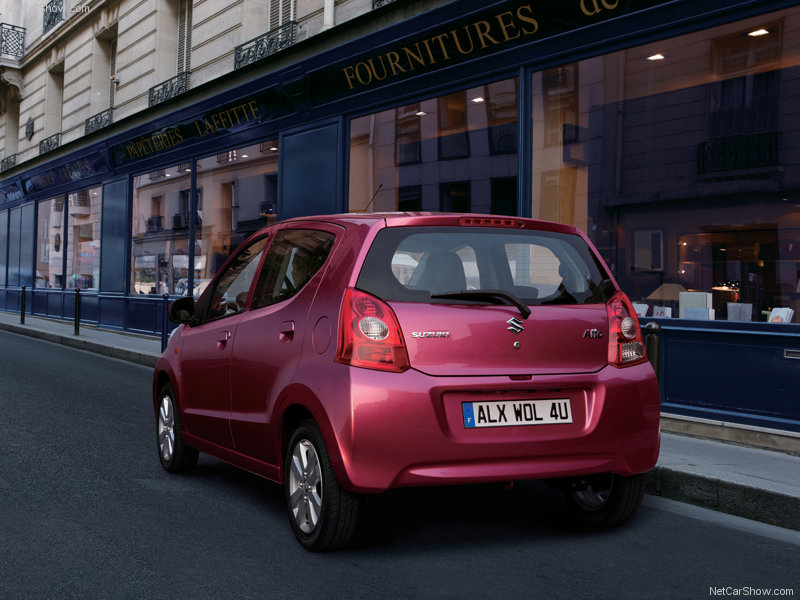 The 6th generation (HA24) was introduced in 2004. The bonnet and headlamps curved down at the front, giving a similar effect to the Toyota WiLL Vi or the Citroen C2. The Alto was re-aligned as a less costly car to accommodate new models such as the Cervo and Alto Lapin. The more powerful engines were moved into the other more upmarket versions like the Suzuki Kei Works and Alto Lapin SS, leaving the Alto with only a 54 PS (40 kW) version. In Japan, this version of the Alto was rebadged as the Nissan Pino and Mazda Carol.The 7th Generation was first shown at the 2009 Tokyo Motor Show alongside its sister car, the Mazda Carol. The 7th Generation is known in India as the Maruti Suzuki A-Star, but is also known as the Suzuki Celerio in some other countries. It was launched in December 2008 by the Indo-Japanese auto maker Maruti Suzuki. The car is manufactured exclusively in Haryana, India and is exported worldwide. It is available in European markets as Nissan Pixo. The car was rolled out to the Indian customers in December 2008 and exports began in April 2009. A-Star means Alto-Star. It comes in three variants - LXi, VXi and ZXi. The initial expected prices in the Indian market are Indian Rupee ₹3.45 lakh (US$7,659) (ex-showroom Delhi) for the LXI, Indian Rupee ₹3.72 lakh (US$8,258.4) for the VXI and Indian Rupee ₹4.06 lakh (US$9,013.2) for the ZXI. With this price tag, the car is targeted at customers with budgets somewhere between the Zen Estilo and the Swift. With a totally new body and engine, Maruti hopes to bring freshness to the Indian car market, of which it already holds a major share. The 998 cc three cylinder K10B was developed especially for the new car. Initial reviews have been positive. The A-Star has a fresh new dashboard, with an available unique protruding tachometer besides the usual meter cowl (only in the ZXi trim). Along with the Swift, SX4 and Grand Vitara, the A-Star is part of an effort to change Suzuki/Maruti's reputation into that of being a producer of stylish cars. Early exports were usually Frontes, as the Alto nameplate was only used on commercial versions in Japan, exported with few changes apart from enlarged engines, sometimes modified bodywork and various different names. Thus the SS40 Fronte became the SS80 Alto with a 796 cc engine.